
The morning scale ritual occupies a peculiar position in the daily routines of people working on body composition. For some, it is a source of information. For others, it is a source of anxiety. The difference, observed across many years of coaching practice, is almost never about what the scale is doing. It is almost always about what the number is being asked to mean.
01 — The Single Number Problem
Body weight on any given morning is a composite signal. It reflects the mass of everything present in the body at that moment: water, food in transit, glycogen stores, muscle, fat tissue, and bone. On a daily basis, most of the variation — sometimes 1 to 2 kilograms across a single week — is attributable to fluid shifts and digestive transit, not to changes in fat tissue.
This is not a secret. It is well-established in published nutritional research. Yet the emotional response to a morning reading often proceeds as though the number represents a direct measurement of fat tissue, which it emphatically does not. The practical consequence of this misreading is a pattern familiar to almost every wellness coach: a single elevated reading produces discouragement, which disrupts the evening routine, which compromises the following night's rest, which produces an elevated reading the next morning.
The exit from this cycle is not motivational. It is structural: it requires changing what the number is used for.
02 — The Weekly Weigh-In as Long-Term Tracking
A weekly weigh-in, taken on the same morning under the same conditions — same time, same state of hydration, same post-sleep protocol — is a more reliable data point than a daily reading precisely because it captures less noise. The weekly number, charted over eight to twelve weeks, begins to reveal a trend line that a daily reading never can.
The accountability rhythm this creates is quieter than daily checking but more durable. Clients who move from daily to weekly weighing typically report a reduction in food-related anxiety within two to three weeks. The freed cognitive bandwidth — no longer spent interpreting daily fluctuations — often redirects toward the practical inputs that actually influence the trend: sleep quality, meal timing, movement cadence.
"Eight weeks of weekly readings tells a clearer story than fifty-six daily ones. The trend is the point. The individual reading is noise."
— Eleanor Whitfield, session notes, February 2026
03 — Sleep and the Reading
There is a well-documented relationship between sleep quality and the morning scale reading that most people underestimate. After a night of fragmented or shortened rest, the body tends to retain more fluid — a consequence of the elevated cortisol levels associated with poor recovery. The reading the next morning is therefore reliably higher than it would be after a restorative night, independent of any food or movement variable.
This means that tracking body weight without tracking sleep quality simultaneously produces systematically misleading data. The morning scale ritual, to be genuinely informative, requires at minimum a basic record of the preceding night: whether the bedtime window was honoured, whether the sleep felt complete, whether the morning energy was present or absent.
A bedside notebook — no more elaborate than a page with the date, a number, and a brief note on rest quality — transforms the morning scale from an anxiety instrument into a tracking tool. The transformation is not metaphorical. It is practical. The data becomes interpretable.
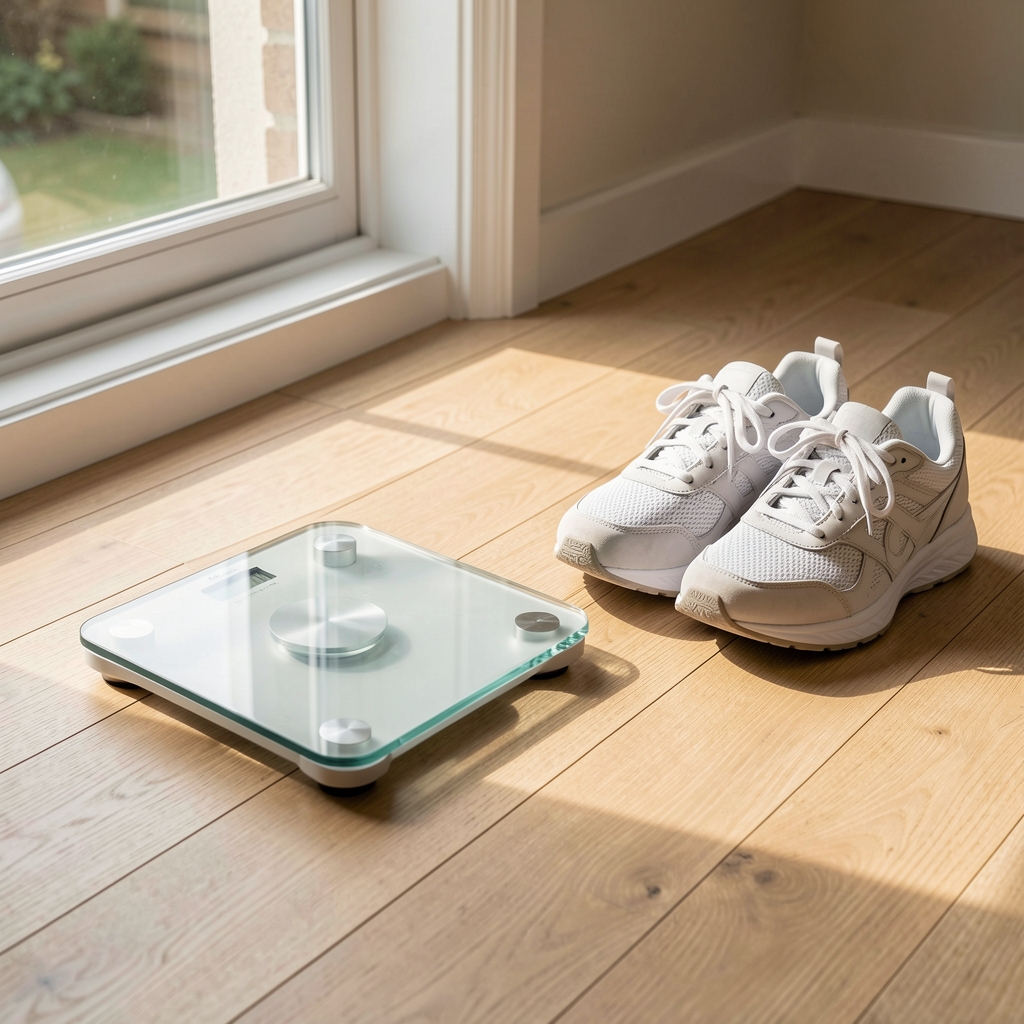
Morning scale ritual. Field observation, London, 2026.
04 — Gradual Progress and the Sustainable Pace
The slow weight loss approach has, over the past decade, accumulated a substantial body of supporting evidence. The rate of fat loss that is physiologically sustainable without compromising metabolic rate, lean tissue, or behavioural adherence tends to be considerably slower than popular expectations suggest: roughly 0.3 to 0.7 kilograms per week under most conditions.
At this pace, the weekly weigh-in becomes both more meaningful and less emotionally loaded. A 0.4-kilogram weekly movement in the trend line, sustained over ten weeks, represents a substantial shift in body composition — one that is invisible in the noise of daily readings but entirely clear in a twelve-week chart.
Consistent sleep quality is one of the most reliable predictors of sustained adherence to this pace. Not because it suppresses appetite in a dramatic way, but because it maintains the decision-making capacity and morning energy and nutrition engagement that make the other inputs — portion awareness, movement scheduling, meal timing — consistently executable rather than aspirational.
05 — Practical Observations
- 01 Weigh once per week, same morning conditions. Record in writing alongside a brief sleep quality note. The paired data is more useful than the isolated number.
- 02 Disregard any single reading that follows a night of obviously poor rest. It contains more fluid-retention information than body-composition information.
- 03 A four-week running average of weekly readings is a more robust indicator of trend direction than any individual week. Consider charting it if the habit is to persist beyond one month.
- 04 Building long-term wellness habits requires anchoring the tracking ritual to an existing morning behaviour: making tea, filling a glass of water, lacing trainers. The ritual is more likely to persist if it is attached to something already present.
06 — What the Numbers Are Actually Measuring
The morning scale measures total body mass at a specific moment. It does not distinguish between the components of that mass. Used daily with emotional investment in the result, it tends to produce more distress than information. Used weekly as one data point among several — alongside sleep quality, energy level, and movement completion — it becomes a useful and undemanding part of a broader check-in cadence.
The shift in perspective is not large, but its practical consequences are. Clients who make it tend to sustain their habits for longer, experience less disruption from ordinary variation, and — over time — achieve more consistent gradual progress than those who weigh daily and respond emotionally to each reading. The patience required is real. The returns, visible in a twelve-week chart, are equally real.